
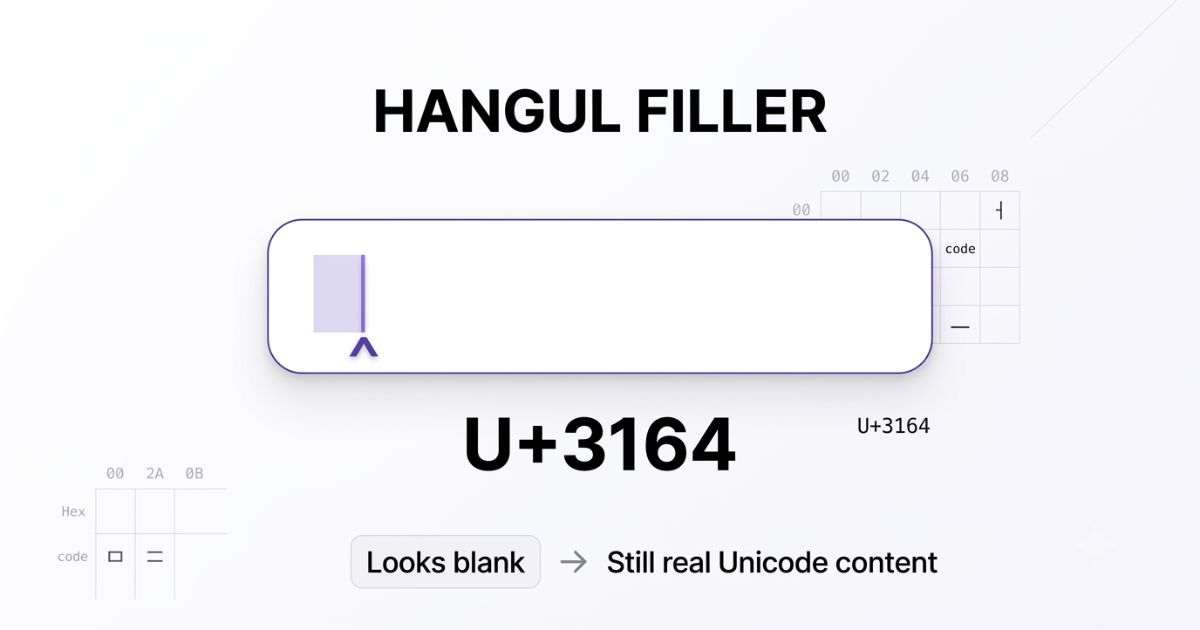
Hangul Filler is a Unicode character with the code point U+3164. It is officially named Hangul Filler and belongs to the Hangul Compatibility Jamo block. It can appear blank in some fonts and interfaces, but it is still a real Unicode character. Unicode lists U+3164 as a special character in this block.
U+3164
Hangul Filler
Copy it below and test it in the field you plan to use.
This guide covers where Hangul Filler comes from, why it behaves the way it does, and where people use it outside of blank profile names.
Where Hangul Filler Comes From
Hangul Filler was added to the Hangul Compatibility Jamo block. Unicode describes U+3164 as a special character and gives it the name Hangul Filler. It is related to the Korean Hangul writing system.
Korean writing uses Hangul syllable blocks. These blocks are built from smaller parts called Jamo. Unicode explains that Korean Jamo include leading consonants, vowels, and trailing consonants.
Unicode also defines filler characters for representing incomplete Hangul Jamo sequences. These include U+115F Hangul Choseong Filler and U+1160 Hangul Jungseong Filler.
| Component | Required in a Syllable Block? | Example |
|---|---|---|
| Leading consonant (Choseong) | Used in a complete modern syllable | ㄱ |
| Vowel (Jungseong) | Used in a complete modern syllable | ㅏ |
| Trailing consonant (Jongseong) | Optional | ㄴ |
Hangul Filler has a specific role in Unicode’s Korean compatibility characters. It is not simply another name for a regular space. Unicode lists U+3164 as a compatibility character and relates it to U+1160, Hangul Jungseong Filler.
What makes Hangul Filler interesting for modern users is how some fonts and applications display it. It can appear blank even though the text contains a real Unicode character.
U+3164 is also an old Unicode character. It was already included in Unicode 1.1.
Why It Can Look Blank
Hangul Filler can look blank because of the way fonts and applications render its glyph. Unicode identifies it as a character, even when its displayed glyph appears empty.
Text fields do not all handle this character in the same way. Some applications may accept it, while others may remove or reject it.
This is also why not every blank-looking character behaves the same way. A character such as zero width space has a different Unicode purpose and may be handled differently by software.
A non-breaking space is also different. It is a space character that prevents a line break at that position. It does not have the same role as Hangul Filler.
A simple way to see this is to compare different characters in the same text field. A regular space may be removed when the field checks its content. Hangul Filler may behave differently because it is a separate Unicode character.
Where People Use Hangul Filler Beyond Usernames
Hangul Filler can appear in several technical and text-processing situations. Here are some examples.
- Korean text processing, where Hangul compatibility characters support older text systems and character mappings. Unicode notes that compatibility Jamo exist mainly for compatibility with legacy code pages.
- Font and text testing, where developers test how software displays Unicode characters.
- Input-field testing, where developers check how applications handle unusual Unicode characters.
- Unicode testing, where developers check whether software correctly stores and displays different characters.
Outside these technical uses, many people encounter Hangul Filler when testing usernames, bios, and messages on social platforms.
Its use in these situations comes from how some systems display the character. However, there is no guarantee that every platform will accept or display it in the same way.
Common Misconceptions About Hangul Filler
| Myth | Fact |
|---|---|
| It is a hacking tool or exploit. | It is a standard Unicode character named Hangul Filler at U+3164. |
| Every app and website accepts it. | False. Applications can handle Unicode characters differently, so some may reject or remove it. |
| It is the same as pressing space twice. | False. It is a separate Unicode character with its own code point. |
| It must be Chinese or Japanese because it looks like an East Asian character. | It is part of the Hangul Compatibility Jamo block and is related to Korean text. |
People sometimes assume all East Asian scripts use the same invisible characters. They do not. Hangul Filler belongs to the Unicode characters used for Korean text compatibility.
It is also easy to group Hangul Filler with every other invisible character. They do not all have the same purpose. For example, the zero width joiner is used in text sequences for joining characters and emoji. It serves a different purpose from Hangul Filler.
Hangul Filler FAQ
What does Hangul Filler mean?
Hangul Filler is the name Unicode gives to the character at code point U+3164. It belongs to the Hangul Compatibility Jamo block and is associated with Korean text processing.
Is Hangul Filler the same as pressing the space bar?
No. A space bar normally produces a regular space character. Hangul Filler is a separate Unicode character with code point U+3164.
Does Hangul Filler work on every platform?
Not always. Different applications can handle Unicode characters in different ways. Some may display it as blank, while others may show a symbol or reject it.
Testing it directly in the field you plan to use is the best way to check.
Why is it called “Hangul Compatibility Jamo”?
Hangul Compatibility Jamo is the Unicode block that contains U+3164. Unicode explains that compatibility Jamo are included mainly for compatibility with older Korean character systems.
Can I use Hangul Filler in a URL or file name?
Some systems may accept unusual Unicode characters, but that does not mean they are a good choice for URLs or file names. Different software can handle Unicode differently.
For URLs and file names, a normal visible character is usually a safer choice.
Is Hangul Filler safe to use?
Yes. Hangul Filler is a standard Unicode character. It is not a script or hidden program. Unicode identifies it as U+3164 Hangul Filler.
Does Hangul Filler count toward a platform’s character limit?
It can. Character limits depend on how each platform counts and processes Unicode text. Do not assume that an invisible-looking character is free from a platform’s character limit.
Next Step
Copy Hangul Filler from the button above, then paste it directly into the exact field you plan to use, whether that is a username, a bio, or a message, before assuming it will work everywhere else.
3 thoughts on “Hangul Filler (U+3164): What It Is & How It Works”
Comments are closed.